
Search engines are the gatekeepers of the internet, but keywords are the keys that unlock them. If you want your website to be found by the right people at the right time, you cannot ignore the fundamental role of keywords. They bridge the gap between what people are searching for and the content you provide to answer those needs. Without a strategic approach to keywords, even the most beautifully designed website will remain invisible in the vast digital landscape. This guide cuts through the noise to explain exactly what SEO keywords are, how to find them, and how to use them effectively to drive sustainable organic growth in 2026.
What Exactly Are SEO Keywords?
At their core, SEO keywords are the specific words and phrases that define what your content is about. They are the linchpins of search engine optimization because they tell search engines like Google the topic of your page and, crucially, match that topic to user queries. When a user types something into a search bar, the search engine scans its index for content containing relevant keywords to deliver the most accurate results. Mastering what are SEO keywords is the first step in communicating effectively with both search algorithms and human readers.
The Definition of Keywords in Search Engine Optimization
In the realm of SEO, a keyword is more than just a single word; it is a concept or a query encapsulated in language. It can be a single word like "marketing," but more often, it is a phrase like "digital marketing strategies for small business." These terms act as signposts. When you optimize your content around specific keywords, you are essentially signaling to search engines that your page is a relevant destination for anyone searching for those terms. This process ensures that your content appears in front of users who are actively looking for the information, products, or services you offer.
Keywords vs. Search Queries: What is the Difference?
While often used interchangeably, there is a nuanced difference between keywords and search queries. A keyword is the term you, the marketer or website owner, target in your strategy. It is the idealized version of a topic, such as "running shoes." A search query, on the other hand, is the actual string of text a user types into Google. This might be messy or specific, like "best lightweight running shoes for flat feet 2026." Understanding this distinction is vital because how to pick keywords for seo involves anticipating the diverse and sometimes unpredictable real-world queries your potential customers are using.
How Search Engines Use Keywords to Index Content
Search engines use complex crawlers to scan the web, reading the text on every page they encounter. They analyze this text to understand the subject matter and store it in a massive database called an index. Keywords are the primary clues these crawlers use to categorize content. If your page features the term "vegan recipes" in the title, headers, and body text, Google's algorithm files your page under that topic. When a user searches for that term, the algorithm retrieves your page from the index. However, modern algorithms are sophisticated; they look for context and semantic relevance, not just exact matches.
Understanding the mechanics of keywords is just the beginning; knowing why they are indispensable for your business growth is the next logical step.
Why Are Keywords Critical for SEO Success?
Keywords are the foundation of every SEO campaign because they align your business goals with your audience's needs. They are not just arbitrary tags; they are insights into the minds of your customers. By targeting the right keywords, you ensure that your traffic is relevant. It is pointless to attract thousands of visitors if they are looking for "free stock photos" while you sell "premium photography services." Effective keyword usage drives qualified leads, increases conversion rates, and builds a sustainable pipeline of organic traffic that doesn't rely on paid advertising.
Connecting Your Content to User Search Intent
Search intent is the "why" behind a search query. Is the user looking to buy, to learn, or to find a specific website? Keywords are the direct link to this intent. If you optimize for "buy espresso machine," you are targeting a transactional intent. If you target "how to make espresso," you are addressing an informational need. aligning your content with the intent behind your keywords ensures that you satisfy the user's query. This satisfaction signals to Google that your page is high-quality, which in turn boosts your rankings.
Helping Google Understand Your Topic Relevance
Google's mission is to organize the world's information, and keywords help it do just that. By consistently using relevant terms and related vocabulary, you establish topical authority. This means you show Google that your site is a credible source of information on a specific subject. For instance, a site about "coffee" that covers keywords like "roasting beans," "brewing methods," and "single-origin" demonstrates depth. This comprehensive coverage helps search engines understand the full scope of your relevance, making it more likely they will rank you for a broader range of related terms.
The Impact of Keywords on Site Structure and Authority
Keywords should dictate not just individual articles, but your entire site architecture. Broad, high-volume keywords often form the basis of your primary navigation and category pages, while specific, long-tail keywords inspire your blog posts and product pages. This hierarchical structure creates a logical flow of information that is easy for both users and crawlers to navigate. A well-structured site based on intelligent keyword research passes authority efficiently from high-level pages to deeper content, strengthening your overall domain authority and making it easier to rank for competitive terms.
With the importance of keywords established, it is crucial to recognize that not all keywords serve the same purpose. Let's explore the different categories you need to master.
The 4 Main Types of SEO Keywords You Must Know
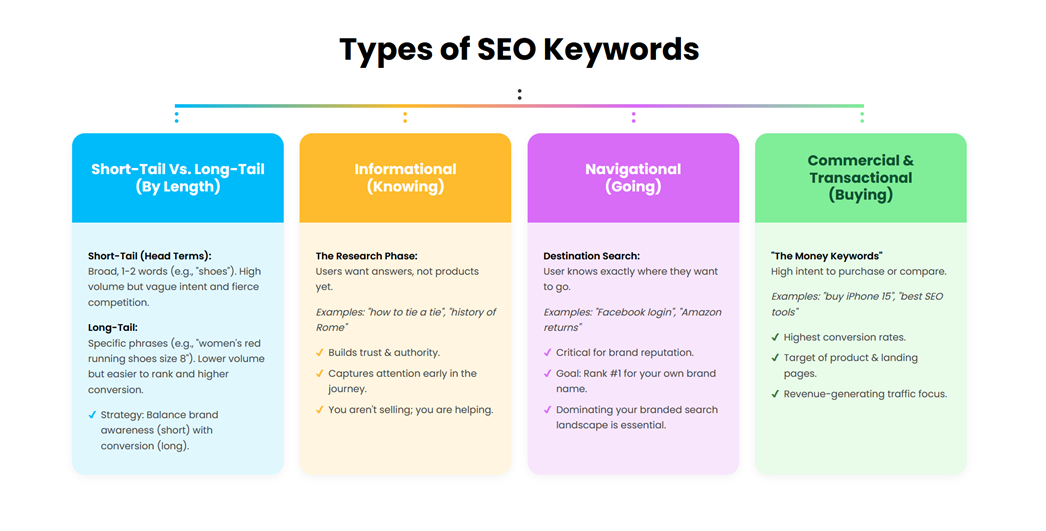
A successful SEO strategy requires a diverse mix of keyword types. Relying on just one kind limits your reach. You need to capture users at every stage of their journey, from the moment they realize they have a problem to the second they are ready to make a purchase. Understanding the different categories of keywords allows you to build a content funnel that guides visitors seamlessly from awareness to conversion. Here are the four main types you must incorporate into your plan.
Short-Tail vs. Long-Tail Keywords
Short-tail keywords, also known as head terms, are broad and usually consist of one or two words, like "shoes" or "marketing." They have high search volumes but are fiercely competitive and often have vague intent. Conversely, long-tail keywords are longer, more specific phrases, such as "women's red running shoes size 8." While they have lower individual search volumes, they are easier to rank for and convert much better because the user's intent is precise. A balanced strategy targets short-tail terms for brand awareness and long-tail terms for conversion.
Informational Keywords (Knowing)
These keywords represent the research phase. Users searching for informational terms want answers, guides, or solutions to problems. Examples include "how to tie a tie," "history of Rome," or "what is keyword difficulty in seo." Content targeting these keywords builds trust and authority. You aren't selling here; you are helping. By providing valuable information, you capture the user's attention early in their journey, positioning your brand as a helpful expert they can return to later.
Navigational Keywords (Going)
Navigational keywords are used when a searcher knows exactly where they want to go. They type "Facebook login," "YouTube," or "Amazon returns" because it is faster than typing the URL. For your brand, these are critical. You want to ensure you rank #1 for your own brand name and specific product names. While you can't easily rank for another brand's navigational terms (nor should you usually try), dominating your own branded search landscape is essential for reputation management.
Commercial and Transactional Keywords (Buying)
These are the money keywords. Commercial investigation keywords like "best SEO tools 2026" or "Mailchimp vs ConvertKit" indicate a user is comparing options. Transactional keywords like "buy iPhone 15 pro," "subscribe to Netflix," or "plumber near me" show the user is ready to act immediately. These terms have the highest conversion rates. Your product pages and landing pages must be laser-focused on these keywords to capture revenue-generating traffic.
Semantic Keywords and LSI (Context)
Semantic keywords and Latent Semantic Indexing (LSI) terms are conceptually related words that provide context. They aren't just synonyms; they are words often found together. If you are writing about "Apple," words like "fruit," "pie," and "orchard" tell Google you mean the food. Words like "iPhone," "Mac," and "Cook" indicate the tech company. Including these related terms helps search engines understand your content's nuance without you having to stuff the main keyword repeatedly.
Knowing the types of keywords is useful, but data must drive your decisions. Let's dive into the metrics that determine whether a keyword is worth your time.
Essential Keyword Metrics to Analyze Before You Write
Keyword research is a data-driven process. It is easy to get excited about a phrase that sounds perfect, but without analyzing the metrics, you might be wasting your effort on a term no one searches for or one that is impossible to rank for. Before you write a single word, you need to evaluate the potential ROI of your keywords. By looking at specific data points, you can prioritize opportunities that offer the best balance of traffic potential and attainability.
Monthly Search Volume (MSV)
Monthly Search Volume (MSV) tells you how many times a keyword is searched for in a search engine each month. It is the primary indicator of potential traffic. A high MSV suggests a lot of interest, while a low MSV might mean a niche topic. However, don't blindly chase the highest numbers. High volume often brings high competition. Sometimes, a keyword with 200 monthly searches is more valuable than one with 20,000 if the smaller audience is highly targeted and ready to buy.
Keyword Difficulty (KD) and Competition
Keyword Difficulty (KD) is a metric provided by most SEO tools that estimates how hard it will be to rank on the first page of Google for a specific term. It is usually scored from 0 to 100. A high KD means you will likely need high-quality content and numerous authoritative backlinks to compete. Understanding what is keyword difficulty in seo helps you set realistic expectations. New sites should target lower KD keywords to build momentum, while established sites can tackle more competitive terms.
Cost Per Click (CPC) and Business Value
Cost Per Click (CPC) is a paid search metric that is incredibly useful for SEO. It shows how much advertisers are willing to pay for a click on that keyword. A high CPC indicates that the traffic for that keyword is valuable and likely to convert into sales. If a keyword has low search volume but a very high CPC, it is often a hidden gem worth targeting because the visitors it brings are highly profitable.
Click-Through Rate (CTR) Potential
Ranking #1 doesn't guarantee clicks if the search results are crowded with ads, featured snippets, and "People Also Ask" boxes. You need to assess the organic CTR potential. If a SERP is cluttered with zero-click features where Google answers the query directly, your potential traffic will be lower even if you rank well. Look for keywords where the organic results are prominent and likely to earn the user's click.
Armed with the right metrics, you are ready to start the hunt. Here is a proven workflow to uncover the best opportunities for your site.
How to Find the Best Keywords: A Step-by-Step Research Strategy
Finding the right keywords is both an art and a science. It requires creativity to understand your audience and analytical rigor to validate your ideas. A haphazard approach leads to gaps in your content and missed opportunities. By following a structured research process, you can uncover a goldmine of terms that your competitors might have overlooked. This strategy will guide you from initial brainstorming to a fully mapped-out content plan.
Step 1: Brainstorming Seed Keywords and Topics
Start by putting yourself in your customer's shoes. What are the core topics your business covers? Write down broad buckets like "running," "nutrition," or "marathon training." Then, list the specific terms you think people would use to find you. Ask your sales and support teams what questions they hear most often. These initial ideas are your "seed keywords." They won't necessarily be your final targets, but they are the starting point for all deeper research.
Step 2: Using Keyword Research Tools Effectively
Plug your seed keywords into professional tools like Semrush, Ahrefs, or Google Keyword Planner. These tools will generate thousands of related keyword ideas based on actual search data. Look for variations, questions, and related phrases. Use filters to exclude irrelevant terms and set minimum search volume thresholds. This is how to find best keywords for seo: use technology to expand your initial list into a comprehensive database of possibilities.
Step 3: Analyzing Competitors and SERP Gaps
Don't reinvent the wheel—see what is already working. Enter your competitors' URLs into your keyword tool to see exactly what terms they rank for. Look for keywords where they rank poorly or have thin content; these are your opportunities to outperform them. Also, conduct a "content gap analysis" to find keywords that multiple competitors rank for, but you do not. This is often the lowest-hanging fruit for quick SEO wins.
Step 4: Leveraging AI for Keyword Discovery in 2026
Artificial Intelligence tools like ChatGPT and Claude have revolutionized research. Use them to generate semantic variations and brainstorm user questions you might have missed. Ask AI prompts like "What are the pain points for someone searching for [Topic]?" or "List related LSI keywords for [Keyword]." This human-like understanding of topics can uncover niche angles and long-tail phrases that traditional tools might not surface immediately.
Step 5: Identifying Seasonal Trends
Search behavior changes throughout the year. "Christmas gifts" peaks in December, while "weight loss" spikes in January. Use Google Trends to identify when interest in your keywords is rising or falling. Planning your content calendar around these trends ensures you publish the right content at the exact moment your audience is looking for it, maximizing your traffic potential during peak seasons.
Step 6: Building a Topical Keyword Map
Don't just create a list; create a map. Group your keywords into clusters based on topic and intent. Assign a primary keyword to a main "pillar" page and related long-tail keywords to supporting "cluster" pages. This maps out your site structure and ensures you don't cannibalize your own rankings by targeting the same keyword on multiple pages. A clear keyword map is the blueprint for a scalable content strategy.
You have your list, and you have your map. Now comes the execution: placing those keywords where they will have the most impact.
Where to Place Keywords for Maximum Ranking Potential
Strategic placement is the difference between a page that ranks and one that stagnates. Search engines look for keywords in specific areas of your HTML code to determine relevance. However, this doesn't mean stuffing your keyword everywhere. It means placing them in the most influential spots while keeping the content readable for humans. Proper placement signals to Google exactly what is important on your page.
Optimizing Meta Titles and Meta Descriptions
Your meta title is arguably the single most important on-page SEO factor. Place your primary keyword as close to the beginning of the title tag as possible. It is the first thing users and search engines see. Your meta description should also include the keyword, not just for ranking, but to bold the term in search results, drawing the user's eye and improving click-through rates.
Incorporating Keywords in H1, H2, and H3 Headers
Your H1 tag should essentially be the title of your page and must include the main keyword. Use your secondary and long-tail keywords in your H2 and H3 subheadings. This breaks up the text for readers and shows Google the structure and sub-topics of your content. It reinforces the main theme while capturing traffic for the specific sub-points you are discussing.
URL Slugs and Image Alt Text Optimization
Keep your URLs short, clean, and keyword-rich. A URL like yourdomain.com/seo-keywords-guide is far better than yourdomain.com/p=123. Additionally, search engines cannot "see" images, so they rely on Alt Text. Describe your images accurately using your keywords where relevant. This not only helps with web accessibility but also allows your images to rank in Google Image Search, opening another traffic channel.
Writing Naturally: Avoiding Keyword Stuffing
Gone are the days of jamming your keyword into every sentence. Keyword stuffing looks spammy to users and leads to penalties from Google. How to use seo keywords correctly involves writing for the reader first. Use your target term naturally where it fits. If it feels forced, read it out loud. If it sounds robotic, rewrite it. Synonyms and natural language variations are your best friends here.
Internal Linking Anchor Text Strategies
Internal links connect your content and spread link equity. When you link to another page on your site, the clickable text (anchor text) matters. Use descriptive anchor text that includes the target keyword of the page you are linking to. This tells Google, "The page I am linking to is about X." It is a powerful signal that reinforces the topical relevance of your linked pages.
SEO is not a "set it and forget it" task. Once your content is live, the real work of monitoring and refining begins.
Tracking and Refining Your Keyword Strategy
The search landscape is dynamic. Competitors publish new content, algorithms update, and user behavior shifts. To maintain and grow your rankings, you must continuously monitor your performance. Tracking allows you to see what is working, diagnose what isn't, and adapt your strategy in real-time. It turns SEO from a guessing game into a predictable growth channel.
Monitoring Keyword Rankings Over Time
Use tools to track your daily or weekly rankings for your target keywords. Are you moving up or down? If you see a sudden drop, investigate immediately. It could be technical issues, a new competitor, or an algorithm change. Consistent tracking helps you defend your top positions and identifies pages that are on the verge of ranking well but need a little extra push.
Why Your Keywords Might Not Be Converting
Traffic is vanity; conversion is sanity. If you rank #1 but get no sales or leads, you might be targeting the wrong intent. Analyze the behavior of visitors from specific keywords. Do they bounce immediately? How many seo keywords should i use that are purely informational versus transactional? You may need to adjust your content to include better calls-to-action or pivot your strategy to target more commercial intent keywords.
Refreshing Old Content with New Keywords
Content decay is real. An article written in 2023 might be outdated by 2026. regularly audit your old content. Look for pages that have lost traffic. Re-optimize them with fresh keywords, updated information, and new sections answering current questions. This "content pruning" and refreshing often yields faster results than writing brand new posts because the URL already has age and authority.
Conclusion
Mastering SEO keywords is a journey, not a destination. From understanding the basic definition to executing advanced research and optimization strategies, every step builds towards greater visibility and authority. By focusing on user intent, leveraging the right metrics, and placing keywords strategically, you create a pathway for your ideal audience to find you. Remember, the goal isn't just to rank; it's to provide value. As you move forward in 2026, keep testing, keep learning, and keep your content aligned with what your users are truly searching for.
Frequently Asked Questions About SEO Keywords
How many keywords should I target on a single page?
There is no magic number, but a good rule of thumb is to focus on one primary keyword per page and 3-5 secondary or long-tail variations. Trying to target too many distinct topics on one page confuses search engines. Instead, create comprehensive content that naturally covers the main topic and its closely related sub-topics.
Can I rank for a high-difficulty keyword without backlinks?
It is possible but extremely challenging. Backlinks act as votes of confidence. For high-KD terms, top-ranking pages usually have high authority. If you lack backlinks, focus on long-tail, low-competition keywords first. As you build authority with that content, you can gradually tackle more difficult terms.
Does keyword density still matter in 2026?
Strict keyword density (e.g., "use the keyword 2.5% of the time") is an outdated metric. Search engines today are semantic. They understand context. While your keyword should appear in key spots like the title and headers, focusing on a specific percentage is unnecessary. Focus on topic coverage and natural readability instead.